Projects
Scaling observed bioreactor performance to watershed decisions
Connect field monitoring with watershed modeling to examine where treatment could be placed and how different adoption scenarios may affect downstream nutrient loads.
- Approach
- Identify nutrient pressures, evaluate bioreactor placement and treatment scenarios, and compare expected benefits with implementation costs.
- Field basis
- Monitoring locations at Geneseo, Walnut, Galva, Rock Creek, Springfield, and Heyworth provide site context for this scale up work.
Loading site map…
Bioreactor based infrastructure at these sites was installed and monitored over the 2017–2026 period; some newer sites have been monitored since 2022. Select a marker to see its location and explore how each site contributes a distinct record over time. Markers may indicate the locality rather than the exact instrument position.
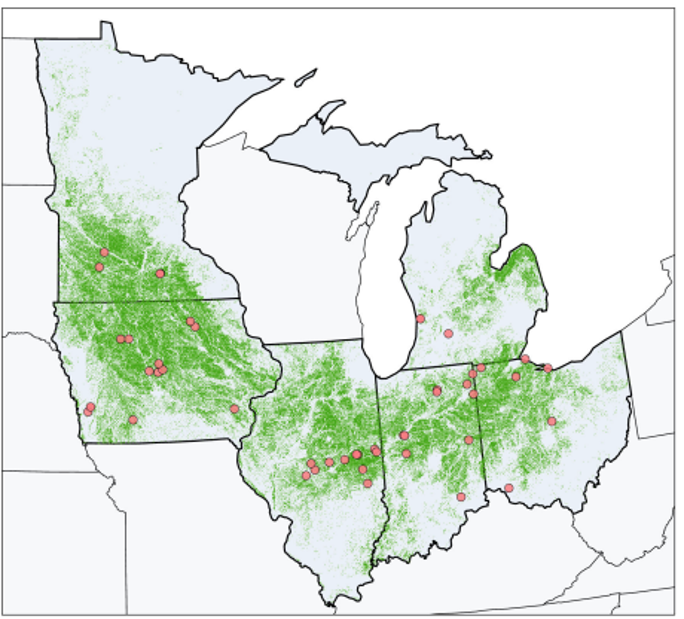
Green shows mapped tile-drained areas; pink points mark field-scale water quality observation sites monitored for at least one full year. The map supports assessment of the techno-economic viability of a two-stage treatment train for nutrient reduction across heavily drained Midwestern landscapes.
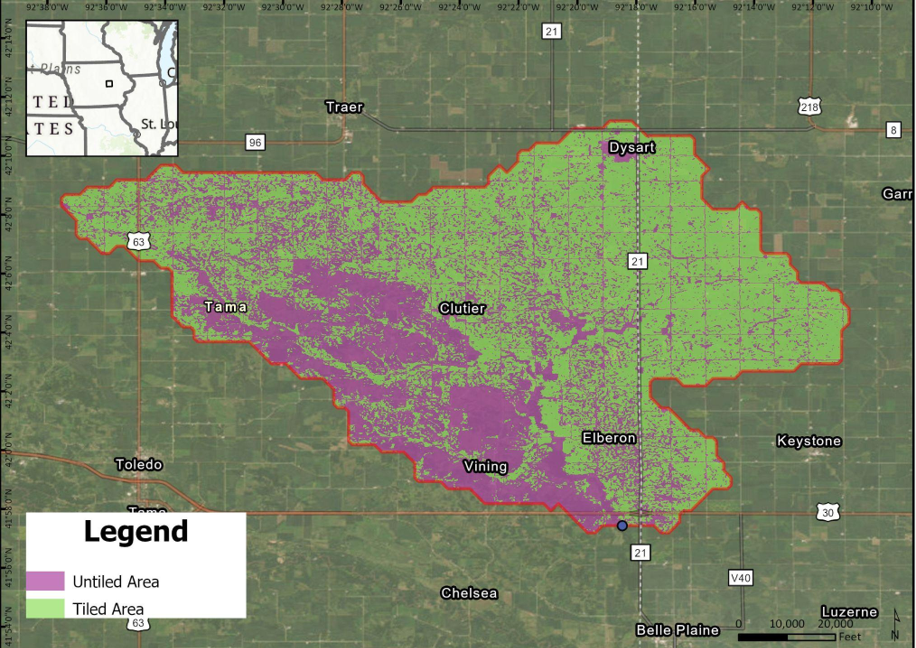
Tiled (green) and untiled (purple) areas, from Figure 1 of the team presentation. View full size ↗
Agricultural drainage and streamflow
Examined how tile drainage and precipitation relate to streamflow and flooding patterns in the Salt Creek catchment near Elberon, Iowa.
- Approach
- Developed a simple watershed water balance model and compared tile drainage scenarios with observed streamflow and precipitation to examine changes in flow patterns over time.
- Finding
- In the study analysis, tile drainage appeared to affect baseflow seasonality, while precipitation had a greater influence on flow magnitude. The simple model did not explain annual flow partitioning fully.
- Team
- Eby Lukose, Haribansha Timalsina, and Rahmat Ekanovin.
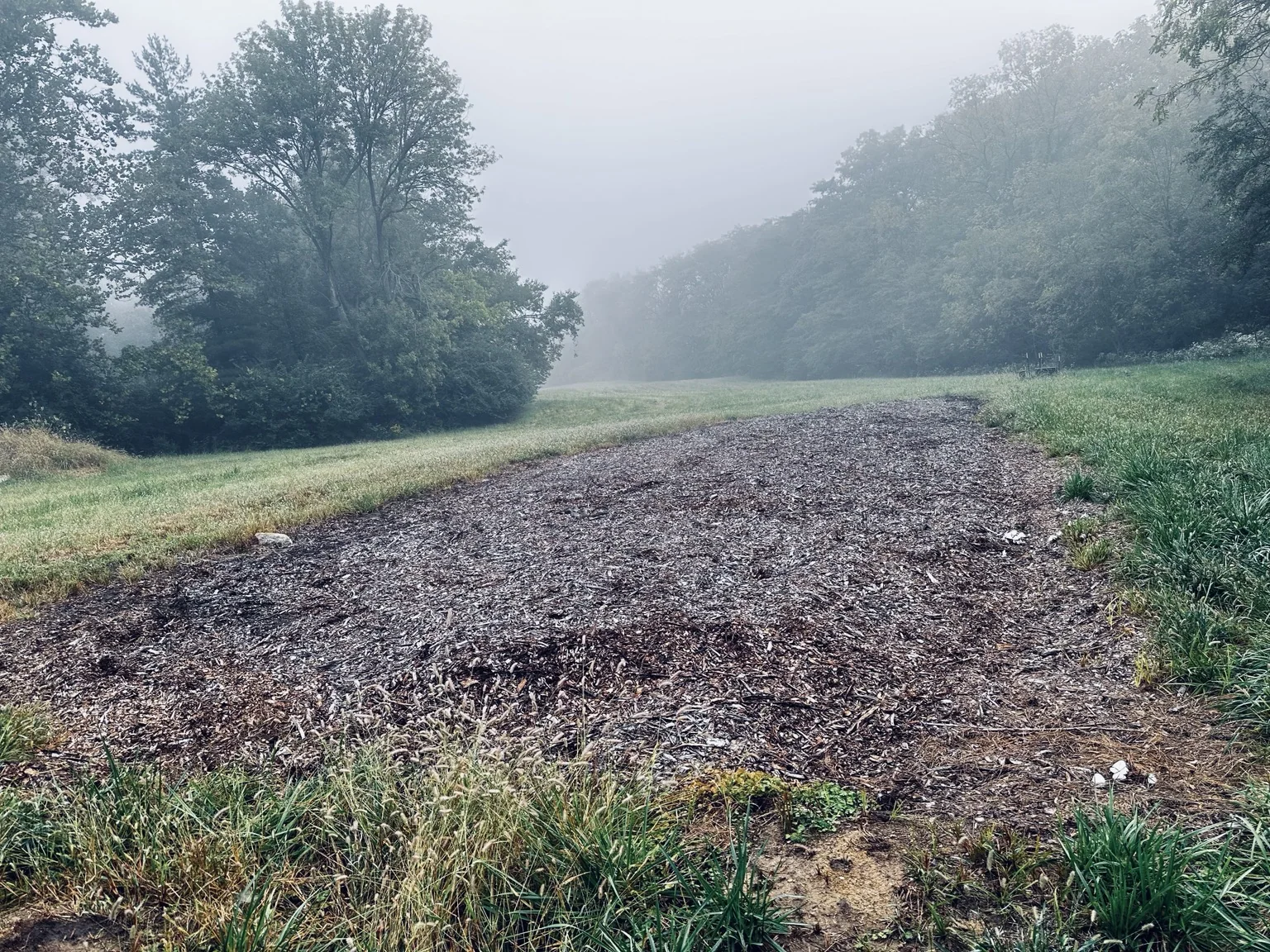
Tracking nutrient removal in agricultural drainage
Monitored flow and nitrate concentrations in a field-scale woodchip bioreactor across changing drainage conditions.
- My contribution
- Field sampling, flow analysis, data checks, modeling, and interpretation.
- Evidence
- The field study reported a 58% average nitrate concentration reduction through the bioreactor.
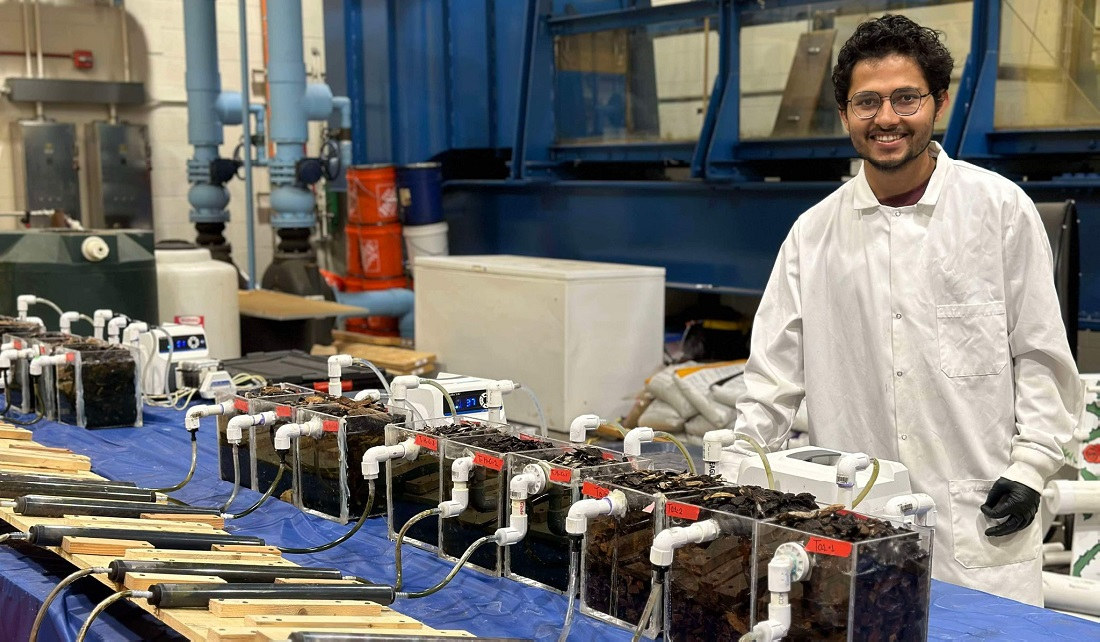
Pairing woodchips with phosphorus filters
Tested how denitrifying woodchips and bottom ash pellets can be paired to address both nitrogen and phosphorus in drainage water.
- My contribution
- Designed treatment configurations, analyzed nutrient removal, and assessed material performance and costs.
- Finding
- Woodchips followed by bottom ash pellets performed strongly across the lab treatment configurations.
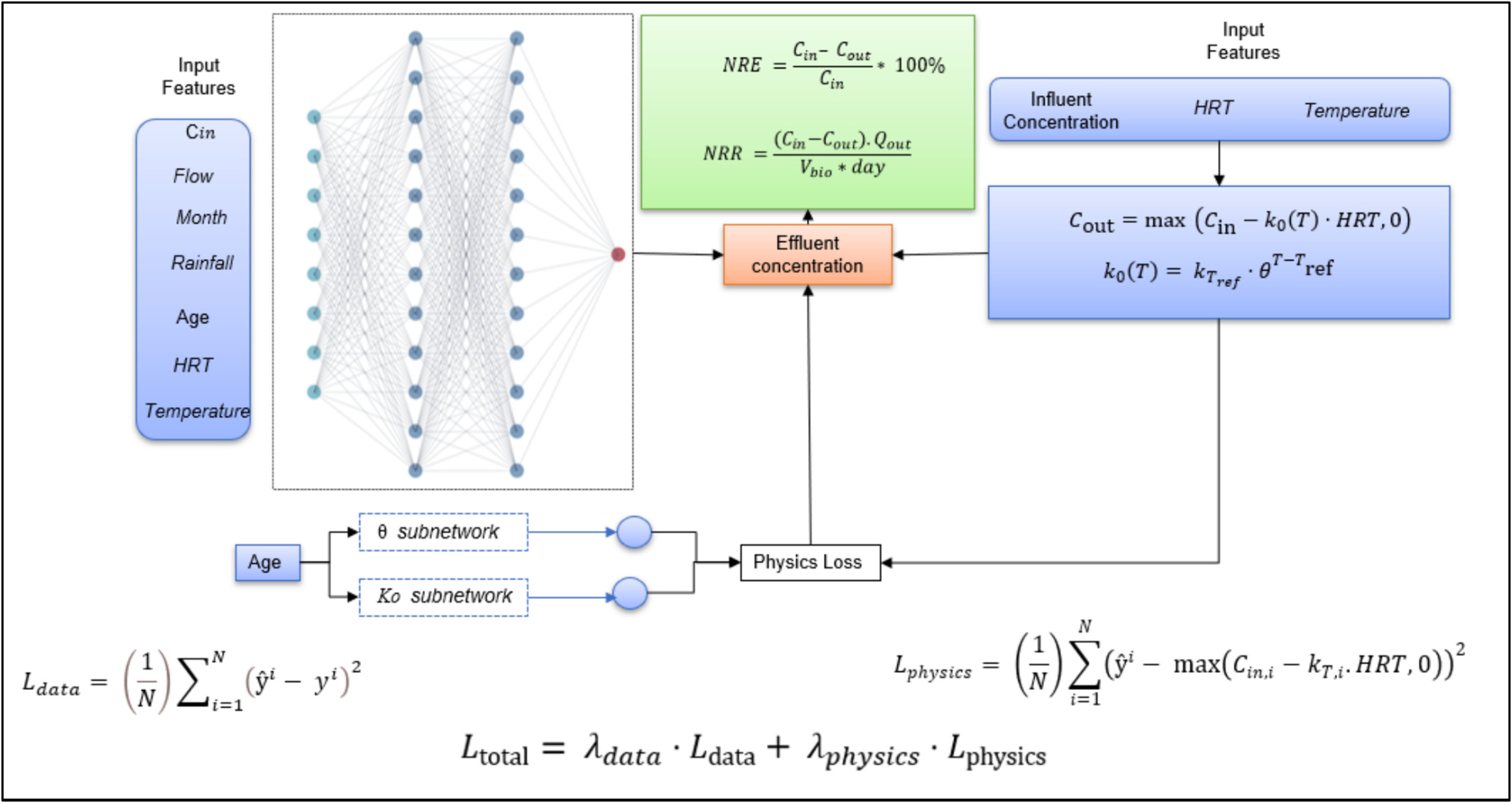
Predicting nitrate removal with a physics-informed model
Combined field observations and process constraints to estimate nitrate removal in woodchip bioreactors, then compared the model with other approaches.
- My contribution
- Prepared field data, trained models, compared predictions, and evaluated transfer across sites.
- Result
- The model substantially outperformed a conventional biokinetic model while matching a purely data-driven neural network’s accuracy. It retained physical consistency and adapted to a new site through partial transfer learning.
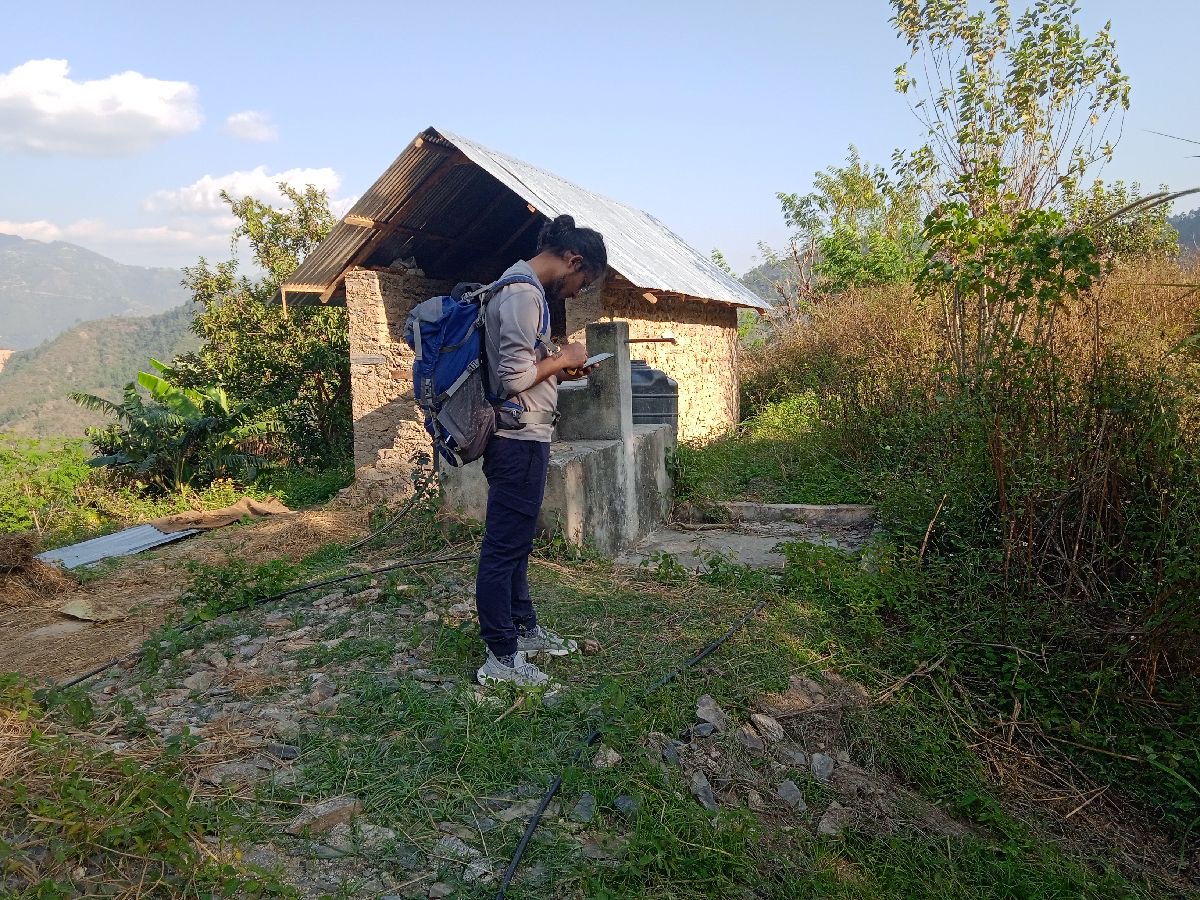
Surveying rural water supply sites
Documented water infrastructure and site conditions to inform planning and hydraulic assessment in rural communities.
- My contribution
- Field surveys, water supply network layout planning and design, cost estimation, and report preparation.
- Output
- Water supply network layout, cost estimate, and engineering report informed by site measurements.
Loading catchment map… Explore the Bureau of Meteorology map ↗
Pan and zoom to explore the NSW catchment boundary ↗. This is an administrative boundary and may differ from the hydrological study area. Explore the Bureau of Meteorology catchment view ↗
Balancing reservoir operations and environmental flows
Analyzed flow changes in the Lachlan River after Wyangala Dam’s enlargement and used a GAMS reservoir model to compare hydropower and environmental flow targets.
- My contribution
- Analyzed hydropower dam operations and ecological flow tradeoffs using a GAMS river basin optimization model, integrating Indicators of Hydrologic Alteration (IHA) for environmental flow targets; co-wrote the results and produced the river network figure.
- Finding
- Modeled wet and normal initial storage met selected monthly flow targets; the dry scenario met them only in August and September.
- Scope
- A 2015–2016 water-year model with estimated monthly demands. The report notes missing precipitation inputs as a limitation.
Also working across stormwater, watershed modeling, and BMP implementation ↗
Communicating project outcomes
Browse selected slides, analyses, and report pages from these projects.
Decentralized nature based water treatment
Designing a treatment train that pairs iron amended biosand and woodchips to study nutrients, microbes, and metals in water used for food production.
Presented by Haribansha Timalsina, 2026.
The Lachlan report is shown in full, page by page. Other projects show selected presentation slides and report pages. Open the full Lachlan report as a PDF ↗